


Saving lives at sea on a dangerous coast:
The Bristol Channel is notorious for its difficult tides and dangerous storms, and there have been many tragedies and brave rescues over the years.

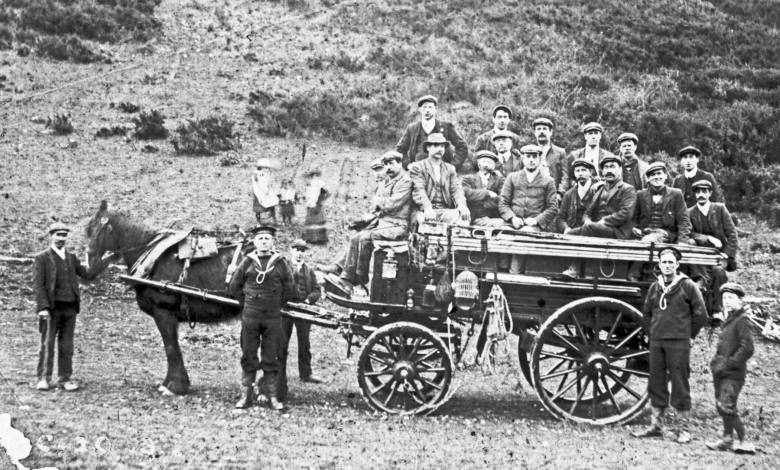
There is a record of some coastguard presence in Llantwit Major in 1871, while in 1895, Eldad Jay was coastguard officer (see photo) and in the early 1900s a lookout point and semaphore station had been built between Stout Point and Pidgeon Point. This was extended in 1914 to include a six-bed dormitory and kitchen for use during the First World War. Around the turn of the century, the Admiralty constructed a building in Baron’s Close to house the life-saving apparatus and rescue cart. (see photo below). This was locally known as ‘the Rocket House’.
In WW2, this became the gas-mask station and in 1946 it was sold and became an off-licence. It is now a flooring shop on the opposite side of the pedestrian crossing from the Well Pharmacy.
By the 1920s, there was a coastal communication service linking Nash Point East and West Lighthouses to the Coastguards at Llantwit – it was later extended to include the Post Office and later included Limpet House in Gileston, while meteorological reports were being received at Llantwit Major Post Office by telegraph. Later, this was replaced by telephone direct exchange lines.
Coastguards were housed in custom built properties – the first two known as the ‘Hollies’ in Flanders Road were first occupied in 1899. In 1923/3, houses were built for the coastguards at the corner of Colhugh Street and Ham Lane South. The Coastguard Officer occupied No 1, which was also the administration office. There was a corrugated shed at the rear which housed the life-saving equipment. These were sold to private ownership in the 1980s.
At this time, maroons were introduced to summon the Coastguard team. They produced a loud bang which could be heard all over the community. People used to flock down to the beach to see any excitement! In the 1930s, lorries replaced the carts and horses to transport the rocket apparatus and breeches buoy.
In the 1950s, Officer EJ Lomax retired and duties were taken over by Officer GV Williams – known locally as ‘Griff’.
Notable recorded events include in 1934, when the Motor Vessel Actuosity (pictured below) was stranded for six weeks off Colhugh Point. In 1938, the French Schooner Ideal was stranded 500 yards off shore at Colhugh Point in a storm. The Llantwit Coastguard team fired eight rockets to try to get a line to the ship but eventually the ninth rocket fired by Alfie Symmonds reached the three men, now on the rigging. The breeches buoy was then used to bring the men (the captain was the last) safely to shore. An excellent report of the rescue can be read in Volume 8 of Aspects of Llantwit Major by Station Officer ET Lomax. Sadly, one man dived overboard when the vessel grounded and was drowned. The breeches buoy was withdrawn from service nationally in 1988.

In 1962, the coastal tanker BP Driver ran aground under the cliffs at Nash Point. Officer Griff Williams and his team rescued all the crew.
In 1979, rescue duties were taken over by Atlantic College. The college is famous for inventing and developing the ridged-hull inflatable lifeboat which is now the RNLI Atlantic Class and is used throughout the service.
A new coastguard station was housed at Llanmaes Road in 2008 in a site shared with the Fire Service and Ambulance.
- Thanks to Tony Wilkins, formerly of the History Society for his research on this subject.
🌟 This article first appeared in the printed edition of the Glamorgan Star on 11.08.22. Read it in print first!

Pencoed tangled up by ‘Seaweeds’
Primary school’s former deputy head is banned from teaching

I make no apologies for calling Plaid Cymru ‘separatists’

‘The importance of participation and continued learning’

Opposition leaders clash with First Minister over independence rally

How Kevin saved a stranger’s life