





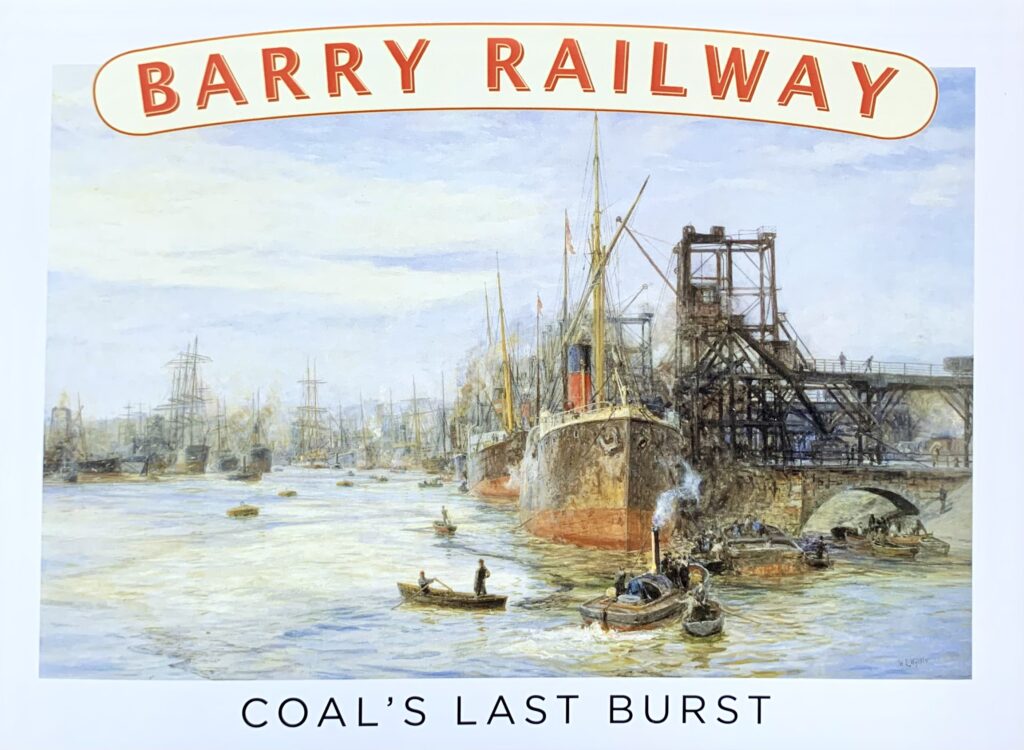
A BOOKLET packed full of facts and figures regarding Barry’s contribution to ‘King Coal’, written by Stephen K Jones, is now available from the Barry War Museum and Heritage Centre.

Glenn Booker of Barry War Museum.
The booklet, entitled Coal’s Last Burst, tells the story of the Barry Railway, and how the superiority of south Wales coal led to the construction of the largest integrated dock and railway system in the world. The cost of the 20-page colour booklet was supported by the South Wales Institute of Engineers Educational Trust (SWIEET).
The chair of SWIEET, Phil Hourahine, said he was pleased that SWIEET were able to support this publication as part of the trust’s remit to help young people take up careers in engineering, and to bring the rich heritage of our engineering past to modern generations.
The following review is by local historian Aldon Grisdale: “There can be little doubt that the author has a solid grasp of his subject, and I was particularly intrigued by his explanation as to why south Wales coal was such a valuable commodity.
“It was superior to north country coal and to any mixture. It had excellent evaporating power, required little stoking, gave less smoke, and occupied less space per ton.
“Some useful space is also devoted to the general background surrounding the development of the earliest docks in south Wales, such as Port Talbot in 1837, which sets the scene for the later shenanigans leading up to the passing of the Barry Docks Bill in 1884. However, I don’t believe that the plotting was covered quite as thoroughly as I might have expected. For example, Lord Windsor purchasing Barry Island.
“Even so, the reader is given a valuable insight into the need to increase export capacity when the author states: “Both Hood and Riches had protested when Lord Bute was considering building a smaller dock than the one authorised by his 1874 Act: Riches stated that if they could not have facilities at Cardiff Docks, they would go elsewhere.
“Of course, they were not the only ones to be rankled by Lord Bute’s attempt to monopolise the coal trade, with the result that Lord Windsor had no other option than to throw in his lot with some of the major players behind the building of Barry Dock, David Davies and Archibald Hood. It was an inspired move, as Barry went on to become the largest coal exporting port in the world, a point clearly made by the author, who goes on to detail the port’s eventual decline.
“In summary, I believe that this type of book will appeal most to those with a real zeal for historical detail, whilst those who thrive on all things Barry, it is also a great addition to material already published on the subject.”
.
- Joe is 100 not out and celebrates with friends in Barry

- For whom the (10) bells toll

- The Vale’s (former) power station is being broken up

⭐ All of our social media in one handy place – here

Pencoed tangled up by ‘Seaweeds’
Primary school’s former deputy head is banned from teaching
I make no apologies for calling Plaid Cymru ‘separatists’

‘The importance of participation and continued learning’

Opposition leaders clash with First Minister over independence rally

How Kevin saved a stranger’s life


