

By Joy Strangward
ON a beautiful sunny morning a group of nine walkers joined Sheila Strangward from Penarth and District Ramblers at the pretty 12th century St Mary’s Church in Wenvoe.
Crossing over the busy A4050 and following Station Road East, they reached the site of the old Wenvoe Railway Station, now in private ownership.
The Barry Railway Company opened the line in 1889, which coincided with the opening of the first dock in Barry and it ran from Trehafod because coal owners in the Rhondda Valley were frustrated at the congestion and high charges at Cardiff and by 1910, Barry had overtaken Cardiff as the largest port exporting coal from the South Wales minefields.
To the north of the station is the 1,868 yard-long Wenvoe tunnel, still intact and housing the main water pipeline to Barry and interestingly during the Second World War, if the royal train was bringing the King and Queen to South Wales their train would be stationed in the tunnel overnight for safety.
Crossing a stile and heading up through farming land at Cwm Slade with its lovely views back across Wenvoe village, before descending through a cool leafy pathway in woodland, upon exiting into the Michaelston valley a vista of yellow, white and green meadows along with neat hay bales in the distance greeted them.

A gravelled path at The Lawns, once the main driveway to the Cwrt-yr-Ala Estate, led them on past fields containing horses along with one that had been planted with a variety of trees.
Just before passing under the A4232, the entrance to the football pitch was being guarded by a friendly gent who informed them that BBC Wales were filming at nearby Pen-y-lan Farm, but unfortunately they didn’t need any extras!
In rising temperatures a fairly steep climb brought them uphill under ancient trees which provided them with much needed shade before exiting into hot sunshine and entering Caerau Hillfort.
Being roughly triangular in shape, it was once the stronghold of the powerful Celtic Silurian tribe who inhabited Wales before the Romans.
BBC Time Team and Cardiff University have had digs there at various times and flint tools and weapons have been discovered along with evidence of post holes.
The massive hillfort has an exciting and rare heritage in that during the early Neolithic era, a rare cause-wayed enclosure was built on the hilltop which provided places for communities to gather, feast and perform rituals.
Three enormous concentric ramparts were constructed while the interior was occupied by a population probably of a few hundred people who lived in timber round houses.
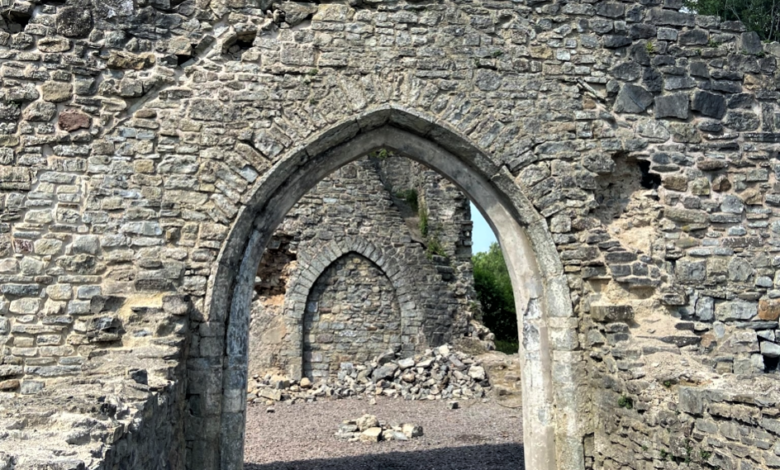
Situated within the remains of the hillfort is the haunting ruined St Mary the Virgin Church which over the years has suffered much vandalism, even recently when stones were removed from the base of the tower upon which is sited a reasonably new cross.
Built during the 13th century on the site of an earlier church, following the Reformation when Henry VIII broke away from Rome, Protestants wrecked the interior, ripped out and destroyed the roof loft and covered the wall murals with whitewash.
It was restored in 1885 and in 1888 the sexton discovered a skeleton and 17th century silver buttons and a coin.
Plus, there was a yew tree said to be 2,000 years-old, but vandals set fire to it in 1937 and in 1957, the church was closed to try to prevent further vandalism.
On 22nd April 1961 the church was re-hallowed and the altar re-consecrated due to the persistence of one man, the Rev Victor Jones and his group of volunteers from St Timothy’s. He camped at the church during repairs to protect it, but in 1973 it finally closed and is now in the care of The Friends of St Mary’s.
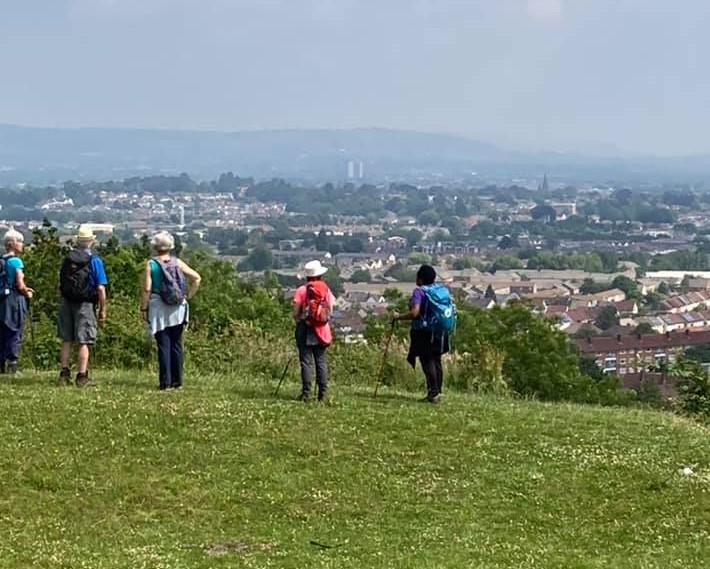
Close to the church is a small ringwork of a medieval castle and heading to the highest point a chance to enjoy the stunning views across the Taff and Ely Valleys towards Garth Hill and Castell Coch, whilst also spotting landmarks in the sprawling City of Cardiff.
Then a descent through winding paths with dry streams, elaborate fungi and plenty of birdsong in part of the ancient woodland of Sweldon in order to re-join the path at The Lawns.
Reaching Michaelston-le-Pit a rough bridle path led them to Wrinstone Farm where they paused to make a fuss of a friendly and beautifully turned out horse.
Then on through a field with young cattle, across the Wrinstone Brook to tramp fields full of tall grasses and multitudes of wildflowers, before heading under the A4050 and a stop to admire an amazing garden in Vennwood Close, before returning to their start point.
You can follow the group’s exploits before, during and after lockdown on Facebook.