

EXPERTS are hoping that changes to the Welsh Blood Service’s Bone Marrow Donor Registry will lead to more remarkable cases such as when a Bridgend man saved the life of a 19-year-old woman in California.
Previously, the registry was restricted to those aged between 17 and 30, but from Sunday 25th March, which was World Cancer Day, people from minority backgrounds have been able to pre-register their interest from the age of 16, while the upper age limit has been extended to 45.
The Welsh Blood Service’s website contains information on joining the registry and a short questionnaire to check eligibility. People who fulfil the criteria will then have the opportunity to order a free swab kit, where they are asked to provide a saliva sample from inside their cheek and return the kit by post. The person is then added to the global database, which is searched every day to try and find donors for patients requiring life-saving bone marrow transplants.
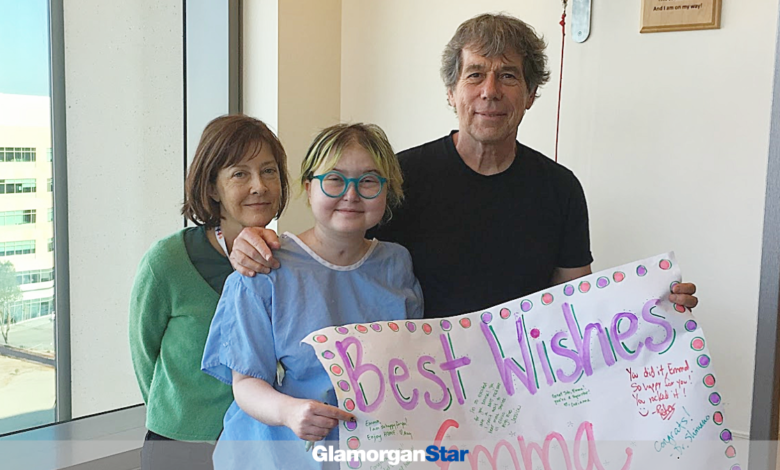
The change to the criteria has been well-received by former patients and survivors throughout the world, including Emma Capps from California who overcame a rare and life-threatening blood disorder thanks to receiving a stem cell donation from Chris Nunn from Bridgend.
Emma became severely ill in 2015 at the age of 18 and her doctors struggled to detect what was causing her illness. Eventually, she was diagnosed with a type of blood disorder called Haemophagocytic lymphohistiocytosis (HLH), a life-threatening condition similar to leukaemia where patients have to go through chemotherapy, immunotherapy, steroid treatment or a stem cell transplant, providing a suitable donor can be found.
More than 5,000 miles away in Bridgend a match was identified from Chris. He said: “My mum died of cancer when I was 12, so when the Welsh Blood Service came to our office and I heard how many different ways I could help people, it was something I knew I had to get involved with.
“I signed up as a stem cell volunteer when I was donating blood at a mobile clinic, but you don’t even need to be a blood donor anymore, you can sign up through a swab kit, delivered right to your door. It wasn’t until around 17 years later that I was contacted and told I was a match for someone in need.
“They said the patient was a 19-year-old female in America and it really hit home for me, my stepson was also 19 at the time. No family should have to go through what Emma’s family went through. I’d do it all again tomorrow if it meant helping someone else.”
After receiving her treatment, Emma went on to complete a dual honours degree programme, receiving a BA in Literary Arts from Ivy League, Brown University and an honours BFA in Illustration from the Rhode Island School of Design.

Emma, who is now undertaking a PGCE in Art and Design at Cambridge University said: “A man I had never met was the only one who could save my life. None of my family members were eligible to donate, so I was placed on the worldwide registry and thankfully, I found Chris halfway around the world in Wales.
“I didn’t squander this precious gift. I worked really hard to get my life back on track. Chris is the reason I am standing here today, having achieved all of these amazing things.
“These changes will make a real difference, and I hope by sharing my story more people will know just how important it is to join the Welsh Blood Service’s registry.”
Following a donation, a two-year anonymity policy prevents donors and patients from sharing identifiable information about one another. In this time, Emma and Chris exchanged letters via the Welsh Blood Service, and eventually swapped contact details, starting a long relationship of email exchanges before they finally met last year in the USA.
Recounting his visit, Chris said: “The first time we met, Emma came running and screeching towards me before wrapping her arms around me. That was the moment it became clear what I had done, and I now count her as a member of my family. It was one of the most heart-warming experiences I have ever had.”
There are currently more than 50,000 patients around the world who are hoping to find a suitable match, and the larger the panel, the greater the chance of finding a well-matched donor for a patient.
Only one in four patients will find a suitable match from a family member. The chances of a volunteer being matched with a patient varies greatly. Some volunteers can be matched after a short time on the registry, and others are never called.
Volunteers who are a potential match will then be asked to give a blood sample, which is needed to determine the exact level of compatibility with the patient. If the level of compatibility is very close, they will be asked to donate bone marrow or give a peripheral blood stem cell donation.
The suitable match will be given detailed information by a specialist nurse about the different procedures, and they can still back out at any time up until the patient starts their pre-transplant treatment.
People can check their eligibility and order a mouth swab kit through the Welsh Blood Service website here.
- Pencoed tangled up by ‘Seaweeds’
- Primary school’s former deputy head is banned from teaching
- I make no apologies for calling Plaid Cymru ‘separatists’
- ‘The importance of participation and continued learning’
- Opposition leaders clash with First Minister over independence rally

- How Kevin saved a stranger’s life

⭐ All of our social media in one handy place – here

Pencoed tangled up by ‘Seaweeds’
Primary school’s former deputy head is banned from teaching
I make no apologies for calling Plaid Cymru ‘separatists’
‘The importance of participation and continued learning’
Opposition leaders clash with First Minister over independence rally
How Kevin saved a stranger’s life