

FOR visitors to Cardiff, a walk around Roath Park is a popular activity but there are changes over time because of the build up of silt which has led to the lake being dredged in the past.
The latest changes have led to the loss of one species of bat and the city council is weighing up a number of options.
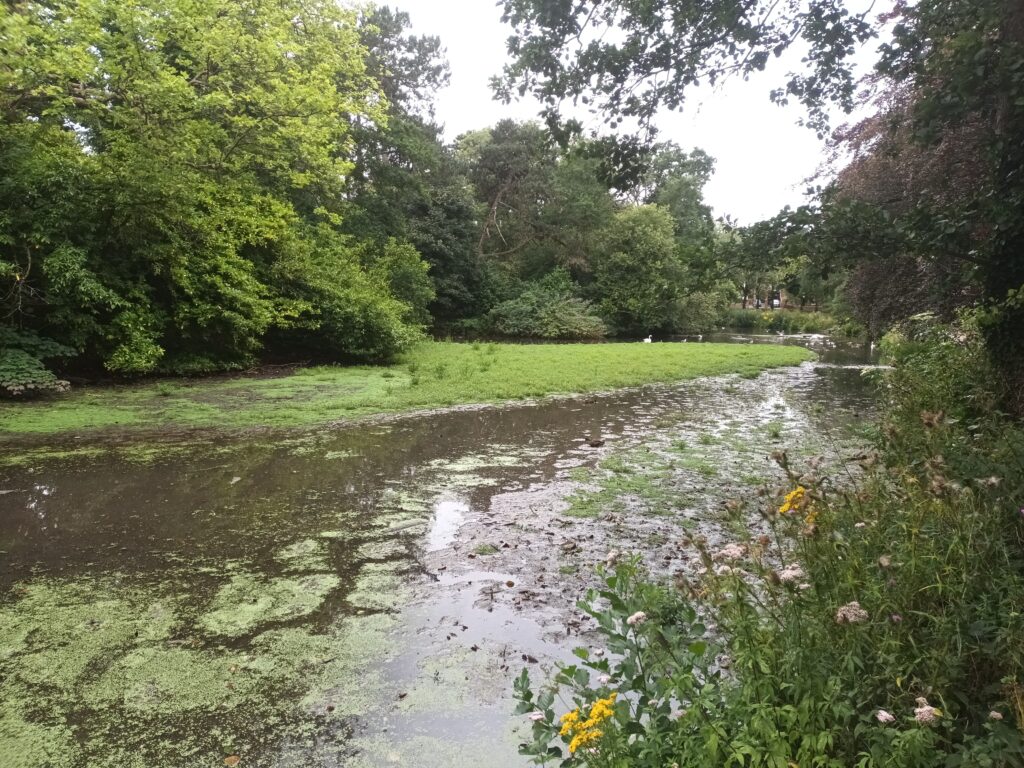
People noted in spring this year that the northern section of Roath Park Lake was starting to silt up and pictures showed it looking more like a muddy swamp than a lake.
More recent pictures show that this section has turned almost entirely green and appears to be teeming with wildlife. However, one ecology expert says the changes could have a harmful effect and has already driven one species away.
Professor Steve Ormerod of Cardiff University said: “Residents have noticed changes in the depth and shape of Roath Park Lake at its northern end where sediment has accumulated to create what are now vegetated ‘islands’ at low flow in summer.
“In some respects, this is a natural process as all lakes tend to trap silt and sediments through the passage of time. However, recent wet winters and high river flows have almost certainly accelerated this process in the lake’s catchment. As well as visual changes, these effects have had ecological consequences.
“For example, the Daubenton’s Bats – specialised bats which feed directly over open water – which used to occur at the northern end of the lake are no longer present.
“Patterns of water circulation have also changed – reducing the flow around the islands in ways that could contribute to blooms of harmful algae and accumulations of plastic.
“There are other water quality challenges upstream of the lake which we’re investigating and we think are linked to misconnected sewers that reach the lake and its associated streams”
Cardiff Council said the potential future dredging of the lake would be considered as part of a scheme to develop a new dam at the southern end of the park.
When residents took to social media in May about the state of Roath Park Lake, it was called a “disgrace” and an “unsightly mess”.
There were also fears that the condition of the lake could result in an increase in mosquitoes during the summer months.
A Cardiff Council spokesperson said at the time: “The council is aware of residents’ concerns around the silt that flows downstream and is deposited in Roath Park Lake and the potential to dredge the lake will be considered as part of the wider Roath Park Dam project.
“The need to ensure the future effectiveness of the dam at Roath Park Lake is completely separate to the issue of silt. However, the extensive works expected to be required as part of the Roath Park Dam project could offer an opportunity to minimise the high costs and disruption associated with dredging.”
Cardiff Council said thecurrent spillway at the Roath Park dam was not big enough to withstand an extreme flooding event. Engineering consultancy firm Arup was appointed to undertake a study to explore the best options.
The preferred option, presented in 2022, is to replace the current spillway with a wider and deeper one and add a flood wall along the promenade. It is hoped the scheme will also include a new open seating area next to the Terra Nova cafe.
By Ted Peskett, LDRS
- Pencoed tangled up by ‘Seaweeds’

- Primary school’s former deputy head is banned from teaching
- I make no apologies for calling Plaid Cymru ‘separatists’

⭐ All of our social media in one handy place – here

Pencoed tangled up by ‘Seaweeds’
Primary school’s former deputy head is banned from teaching
I make no apologies for calling Plaid Cymru ‘separatists’

‘The importance of participation and continued learning’

Opposition leaders clash with First Minister over independence rally

How Kevin saved a stranger’s life