



How to spot a tsunami in Cardiff
Local history with Graham Loveluck-Edwards



AS regular readers of my column will know, I am all too absorbed with the history of our oldest and most interesting pubs.
The Prince of Wales in Cardiff city centre may not be anywhere near the oldest but its chequered history is nonetheless fascinating. When I was little, my mother used to hurry past it on days out in Cardiff. I subsequently learned that this was because in the 1970s it was a known hang out for the grubby mac brigade, a cinema that only showed ‘blue movies’ to customers over 18.
Its origins though are far grander. It was originally built as a theatre in 1878. It was Cardiff’s second Theatre Royal after the Crockherbtown Theatre Royal, which stood on Park Place but was destroyed in a fire.
This place was also burned to the ground in 1899 but was subsequently rebuilt in its original style, and then had a big refit in the 1920s, creating some of the wall and ceiling features you can still see in there today.
Historically, the most interesting thing about the Prince of Wales is on the outside wall on its south facing side – the side nearest the railway station. You can see in the masonry a clear brick outline of what is unmistakably a church building (see photo below). That is because the lost church of St Mary’s originally stood on this site. Hence the street in front of it being called St Mary Street.

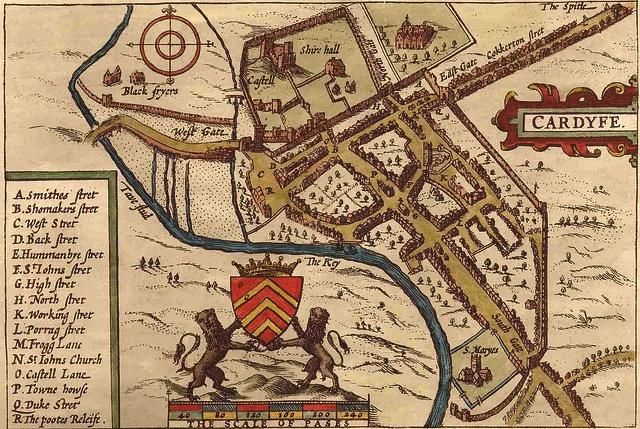
St Mary’s is marked on Speed’s map of Cardiff (below), published in 1610. Even though it is not to scale you get the impression that the church was vast. It would have dwarfed most cathedrals.
What happened to the church
So, what happened to it? It’s one thing to lose your keys or a pen, but to lose a church sounds very careless. It was destroyed in 1607 when a tsunami swept up the Bristol Channel, devastating buildings and settlements in south Wales and Somerset. St Mary’s Church was one of its victims. There were plans to rebuild it, but they were never executed.
All we have as a reminder is the brickwork on the Prince of Wales, a tribute to its somewhat godlier forebearer.
.
- Joe is 100 not out and celebrates with friends in Barry

- For whom the (10) bells toll

- The Vale’s (former) power station is being broken up

⭐ All of our social media in one handy place – here


Pencoed tangled up by ‘Seaweeds’
Primary school’s former deputy head is banned from teaching

I make no apologies for calling Plaid Cymru ‘separatists’

‘The importance of participation and continued learning’

Opposition leaders clash with First Minister over independence rally

How Kevin saved a stranger’s life


