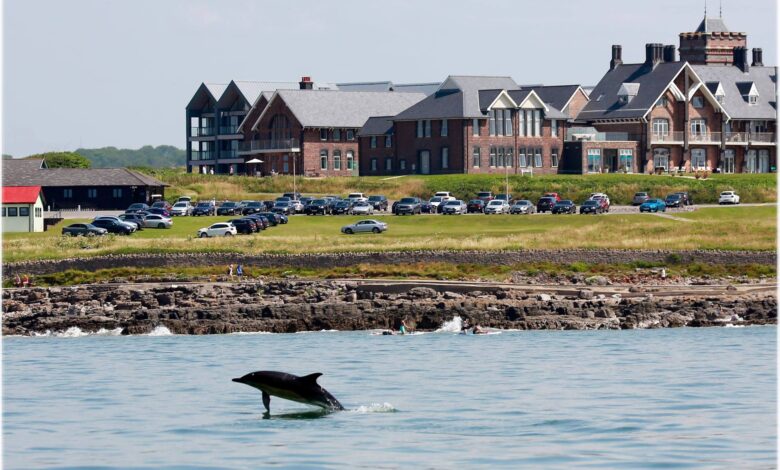


Volunteer crew members at Porthcawl RNLI have had company recently on their call outs and training exercises.
A school of dolphins have been regular visitors – possibly connected to the hot weather – although the south Wales coast does see dolphins and porpoises quite often.
Stephen Jones of Porthcawl RNLI took these pictures and it prompted Bridgend County Borough Council to issue safety advice as people flock to the coast.
Before entering the water
Whatever the activity, weather forecasts and sea conditions should always be checked in advance to make sure they are suitable. As well as being fit for purpose, all equipment should be clearly marked with a name and contact details, and lifejackets or buoyancy aids should be worn at all times.
Anyone entering the water should familiarise themselves with shallow areas and charted obstructions and inform someone on shore of their movements. They should remain aware of equipment which could cause harm if touched – for example, boards, fins, lines and sails – and maintain a safe distance from others who may be in the water or on the beach.
High-visibility apparel, brightly coloured tow-buoys and swim caps can aid visibility while in the water, and a waterproof grab-bag containing items such as a radio, mobile phone, flares or a torch is recommended.
Swimming
Always swim within your limitations and avoid swimming alone. Tell someone on shore where you are swimming and when you expect to return and be aware of the cold and the effects it can have on the body once immersed in water. To avoid collisions and accidents, consider what you will wear to make sure that other users and vessels can see you, or whether a tow-buoy is required.
Things that should always be avoided include diving or jumping from a structure into water of an unknown depth, swimming in strong currents and tides, and swimming after drinking alcohol or consuming food.
Never swim near a moving boat or around a vessel which is moored with its engine running, and always avoid swimming across the access channel of marinas.
Only swim between red and yellow flags on lifeguard-patrolled beaches, and if you get into trouble, lie on your back in the ‘Float to Live’ position and relax, resisting the urge to thrash about.
Anyone who spots a swimmer in trouble should call 999 or 112 in an emergency and ask for the Coastguard. For more details, visit the RNLI website.