

The legend of ‘The Golden Mile’
By Graham Loveluck-Edwards
Glamorgan folklore is awash with countless stories about the Norman invasion of Morgannwg (which at that time was the south Wales kingdom spanning between the Severn and Neath estuaries).
Many of these tales are no doubt based on some real history, but the narrative inevitably drifts off at some point to allow the bards who retold them to entertain their audience more fully. We are lucky that many were captured in the 16th Century by Sir Edward Stradling in his book The Winning of the Lordship of Glamorgan out of Welsh-men’s Hands.
One of my favourites concerns how Iestyn Ap Gwrgant, King of Morgannwg, enlisted the help of the Normans to settle a dispute. But at what cost?
There was nothing the ancient kings and princes of Wales loved more than a good fight amongst themselves, and Iestyn Ap Cwrgant and Rhys ap Tewdwr of Dehaubarth (west Wales) had been at it for years.
The legend has it that Iestyn was getting frustrated at how long the feud had been running. Both sides were equally matched on the battlefield, neither was willing to back down, and there had been much bloodshed for very little gain.
So, after consulting his closest and wisest councillors, he agreed to send one of them, Einion Ap Collwyn, to meet with Robert Fitzhamon, the Norman earl of Gloucester, to ask for his help in defeating his troublesome neighbour. Einion was a natural choice for the job, as he was not only a knight who had proven his loyalty to Iestyn many times on the battlefield, but he was also himself of royal descent.
He was the brother of Cadifor, the former prince of Dyfed who had been deposed by Rhys. Their family were well known to the English nobility, and there are even suggestions that Einion served William II when he was in France. Iestyn promised Einon that, if his mission was successful, he would grant him his daughter’s hand in marriage, thus aligning their two royal households for eternity.
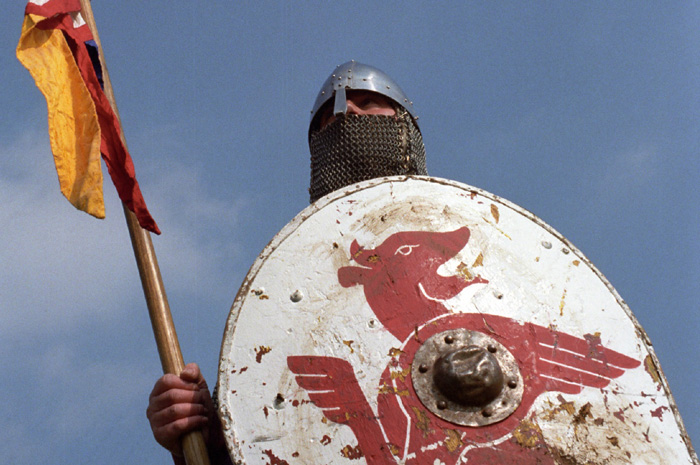
Einion met Fitzhamon and negotiated a deal whereby the Earl would lend Iestyn the hired muscle of his 12 most trusted knights and their cohorts of soldiers in return for ‘a mile of gold’. The two men shook hands on the deal and Einon returned to Morgannwg with his mercenary force in tow.
Buoyed by this vast tactical advantage, Iestyn threw down the challenge to Rhys to meet him in battle at Brecon. With Iestyn’s own forces bolstered by the mighty armies of the twelve knights, he won easily, and Rhys’ army was beaten.
Rhys took flight, and Iestyn’s troops pursued him all the way to Hirwaun, where they finally caught, trapped, and killed him. It had been a great victory.
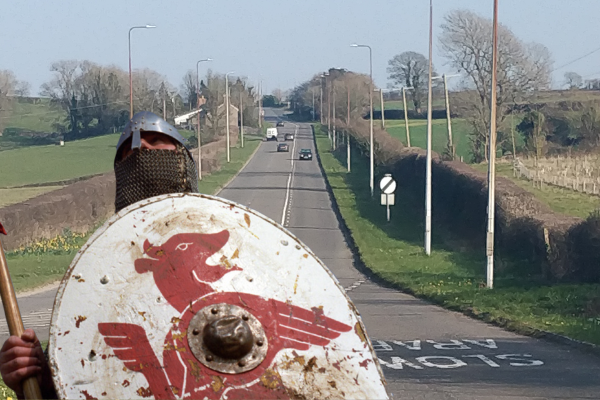
During the ensuing victory celebrations, the Norman troops marched to a mile-long section of the old Roman road (the Via Julia Maritima which was built in the Antonine period to link the forts between Gloucester and Neath – these days mostly followed by the A48). They lined up in one long rank and gold coins were placed side by side along the line of soldiers so that Fitzhamon would get his promised ‘mile of gold’.
Each soldier would bend down, pick up the coins nearest them, then march back to Gloucester with their treasure. The stretch of road in question has ever since been known locally as ‘the Golden Mile’. I believe it is the stretch of the A48 between the top of Crack Hill and Pentre Meyrig in the Vale of Glamorgan, although others argue that it runs from the bottom of Crack Hill to roughly where ‘Bridgend Ford’ is.

For Einon, the joy of victory in battle was short lived. He turned to Iestyn to remind him of his promise of his daughter’s hand, but Iestyn denied having ever made such a commitment and refused him. Outraged that he had been duped, the broker of this victory, and the only one not to have profited from it, he returned to Gloucester and asked Fitzhamon if he would join forces with him and turn against their former ally.
Fitzhamon needed little persuasion. He saw a chance to gain wealth and land for himself. So Einion, Fitzhamon and the twelve knights returned to Wales and destroyed Iestyn’s army in a fierce and bloody battle. They sacked his castle and court and, in the legend, killed Iestyn in the battle, although other records suggest he lived until 1093.
Thus began the Norman occupation of South Wales.
- Graham Loveluck-Edwards is an historian and author of ‘Legends & Folklore of Bridgend and the Vale’ and ‘Historic pubs of Wales’. View his videos on local history by visiting his new YouTube channel at youtube.com/user/GrahamLoveluck .
—
| The views expressed by columnists of this newspaper do not necessarily reflect the views of the Glamorgan Star, its employees, or proprietors.


| Scroll down to comment on this article
• | Did the Pope make the lord of the manor an offer he couldn’t refuse?
THE MYSTERIES OF EWENNY PRIORY


Former Barry office building transformed into vital new homes

Prolific thief banned from entering shops in Barry

I’m proud that all parties agreed on children in care plan
WHEN you elected me in May, I said I had come to listen and to…

Royal Welsh highlights the role of the rural economy

Parent may have to lose job for school run

Double victory for Pencoed cricketers

| Scroll down to comment on this article