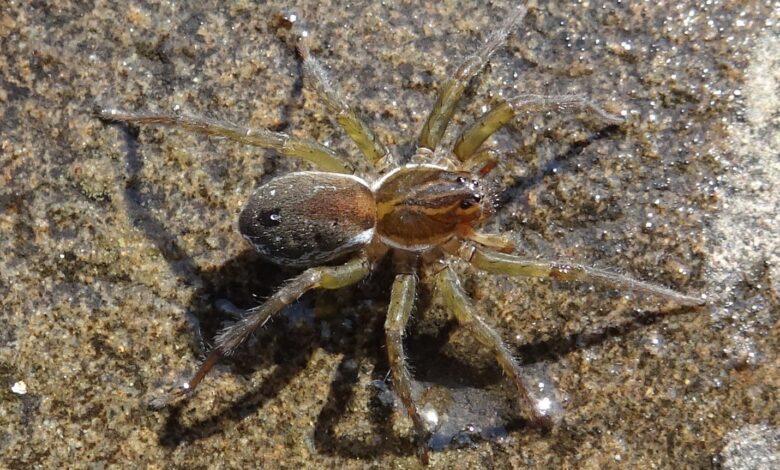


WHEN Rob Nottage, one of the Old Hall Gardeners in Cowbridge, dragged some sticks and debris out of the pond, he found that he had fished out an unusual-looking spider.
Luckily, Linda Nottage was ready to capture it with her camera. It turned out to be Pirata piraticus – commonly known as the Pirate Wolf Spider, belonging to the family Lycosidae (from ancient Greek: ‘lykos’ meaning ‘wolf ’).
Unlike many spiders, wolf spiders do not catch creatures in a web; instead, they use their jaws and legs to immobilise their prey. It was once thought that they hunt as a group, hence the name ‘wolf ’ spider, but in fact they generally hunt alone.
Pirata piraticus can walk quite fast over water by means of water-repellent hairs on its legs, and it can move even faster across pond weed and other floating leaves. Like most spiders it has eight eyes, arranged in two rows – so it has keen eyesight to help it hunt down its prey. Look out for it in a wide variety of wetland habitats including ponds and stream margins. In sunny weather it will hunt in the open, but in cooler weather it will hide amongst vegetation.
The females make good mothers, carrying their egg sac with them, attached to the spinneret. When the eggs hatch, the babies climb onto their mother’s back until they are old enough to fend for themselves. The adult spiders are about 6–9 mm long, and you’ll see them mainly during the summer.
There is no logical reason for us to fear spiders in the UK as none of them will do us any serious harm. However, there are a few that will inflict a nasty bite that can penetrate human skin and, in severe cases, cause symptoms such as swelling, redness, sweating or dizziness. As yet, though, no deaths have been recorded in the UK from a spider bite. If you find one trapped in your house and you don’t like to touch it: throw a towel over it and shake it out of the window to safety.
As for those cobwebs that you might fight when doing your housework: marvel at the amazing qualities of a spider’s silk thread. It is incredibly strong and flexible, with some varieties being five times as strong as an equal mass of steel! It’s no wonder that it has become the subject of scientific research and that humans are looking at how they could harness that astonishing strength for new materials.
Keep up to date with Old Hall Gardens via our Blog on: www.oldhallgardens.org
Report by Biga John.
Like or comment on this article below.