

Pause for thought –
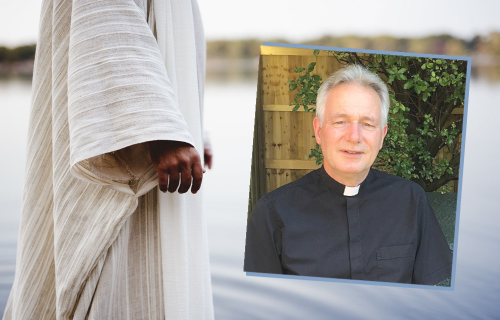
By Rev’d Robert Parrish:
Discussing miracles does not weaken your faith
During the hot summer of 1976, I worked as a courier for a well-known travel agency.
On hearing that I was going to study theology, one of the holiday makers asked me a question, “Do you really think a man could walk on water?” Before I could attempt an answer, the man’s wife intervened, telling him to be quiet. “But I was only asking Robert a question” he protested. “No you weren’t”, she replied, “you were picking an argument so you could show off.”
Over the years I have wondered how I might have answered the man’s question. I could have said “No, I don’t think a man could have walked on water, but Jesus wasn’t just a man, he was the Son of God”. But I doubt if that would have carried any weight with someone sceptical about religion.
Alternatively, I could have suggested that the story of Jesus walking on water might have a natural explanation. For the Greek word ‘epi’ which the New Testament uses to describe Jesus walking on the lake, can mean both on and near. So, did a story about Jesus meeting his disciples near the lake grow, by way of a misunderstanding, into a story about Jesus meeting them on the lake?
In the Gospel of Matthew (Chapter 14 v23-33) the disciples in their boat see Jesus walking on the sea, and Peter tries to walk on the water to join him. But in the Gospel of John (Chapter 21 v4-7) Jesus is spotted standing by the seashore from the boat, and Peter jumps into the water and wades across to join him. Are these two stories different versions of the same event, with John’s version closer to what really happened?
If my conversation with the holidaymaker had got into its stride, he might have gone on to ask me, “And do you think a man could have miraculously fed five thousand people?” Might this miracle also have a natural explanation? A crowd had followed Jesus to a remote spot to hear him teach and were now in need of food. A boy offered him five loaves and two fish, which Jesus is said to have multiplied in order to provide food for everyone (John 6 v1-16).
But it is possible that the boy’s generosity shamed others who had brought food with them into sharing, so there was enough to go round after all. If so, the story is really about the generosity which Jesus inspires in us to help those in need, rather than about a nature bending miracle.
Some of you may feel that to even question the miracles of Jesus is disrespectful. If so, you will have to answer two difficult questions if you are ever confronted by someone like my holidaymaker.
First, the science question. Are miracles even possible? As the physicist Stephen Hawking once wrote, “I believe the universe is governed by laws of science. The laws may have been decreed by God, but God does not intervene to break the laws”. Second, the moral question. If God can miraculously provide food, why does He allow thousands around the world to die of hunger every day?
In the modern world Christians face many challenges to their faith. If ever I feel overwhelmed by all the questions facing us, I re-read these words of the French philosopher Simone Weil:
“One can never wrestle enough with God if one does so out of pure regard for the truth. Christ likes us to prefer truth to him because, before being Christ, he is truth. If one turns aside from him to go toward the truth, one will not go far before falling into his arms”.
- The views expressed by columnists of this newspaper do not necessarily reflect the views of the Glamorgan Star, its employees, or proprietors.
🌟 This article first appeared in the printed edition of the Glamorgan Star on 17.11.22. Read it in print first!

| — The Gospel according to… Judas? (Strangely, that one failed to catch on!)

Pencoed tangled up by ‘Seaweeds’

Primary school’s former deputy head is banned from teaching
I make no apologies for calling Plaid Cymru ‘separatists’

‘The importance of participation and continued learning’

Opposition leaders clash with First Minister over independence rally

How Kevin saved a stranger’s life