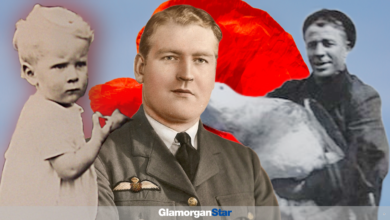


Dr Jonathan Hicks pays tribute to a young man from Penarth who was awarded a posthumous Victoria Cross for his courage during the Great War.
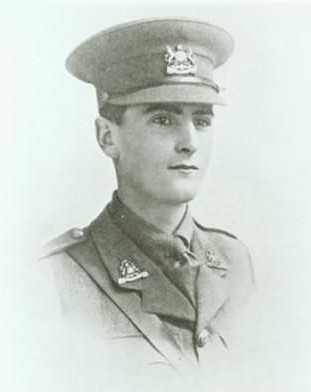
RICHARD William Leslie Wain was born at 4, Victoria Square in Penarth on 5th December 1896.
His father was a solicitor who worked at Bank Buildings in St Mary Street in Cardiff. His elder sister, Elsie Madeline, was born in January of 1896. His grandfather, also named Richard Wain, was a hotelier, first in Brynmawr, and later in Penarth.
After attending the Llandaff Cathedral School, Richard was sent to St Bees, a prestigious independent school in Cumberland, and was educated there from 1911 to 1914. He passed the Higher Certificate, Oxford and Cambridge Joint Board, joined the Officer Training Corps, and was the Holder of a House Scholarship. Intending to go to Oxford University, his plans were halted by the events of the summer of 1914.

He joined the 7th (Reserve) Battalion of the Welsh Regiment, a ‘Cyclist Battalion’ which never saw active service. Richard transferred to the 16th Battalion of the Middlesex Regiment, with whom he underwent basic training. He was commissioned into the Manchester Regiment on 3rd July 1915 and joined the 17th Battalion on 16th July 1915 at Belton Park, Grantham.
After completing training at Larkhill on Salisbury Plain, the battalion was posted to France in November, Richard Wain joining them some time afterwards as a second lieutenant. At the end of June, they moved to the Somme area in preparation for the great attack.
On the evening of 30th June, the battalion moved into the trenches north-east of Maricourt and at 8.30am the following morning, Richard Wain and A Company advanced towards the German lines. Second Lieutenant Kenneth Callan-Macardle (killed on 10th July) wrote later: “The ground was so rough and broken with shell holes that when I lay down under our barrage, I found myself ahead of the first line – I had four men left. The 17th had advanced too quickly. We had done it all at the slowest walk and been quite unchecked – so we lay down for 40 minutes, under the shells, waiting. Waiting is hard. We were to rush the village at 9.56.
“The time came. I was watching A Company to see them rise and the seconds ticked on. I hailed a sergeant and asked him, shouting in his ear, where his officers were. “All gone, Sir”, he shouted back.
“I caught a glimpse of young Wain, his face haggard with pain, one leg soaked with blood, smoking a cigarette and pushing himself forward with a stick. His voice was full of sobs and tears of pain and rage. ‘Get up you b……s. Blast your souls – get up’. I waved to him and he smiled and dropped – he knew it was not absolutely up to him any longer. We of B Company took over, for he was the last of A Company officers and their Sergeant Major was also killed.”
Richard Wain was by now unable to walk and was evacuated back to the Regimental Aid Post and then via a Field Ambulance to a Casualty Clearing Station. The wound to his leg was so serious that he was evacuated back to Britain where he spent time recovering from his injuries.
After recovering, he was transferred to the Heavy Branch of the Machine Gun Corps on 2nd January 1917 and was posted to A Battalion in France where he underwent training in a new weapon – the tank. In April he spent 10 days’ leave in Paris and on returning joined his unit in Belgium where preparations were underway for the great battle of Messines.
By now promoted to the rank of lieutenant, on 7th June he led his crew on the first day on the attack across marshy ground, totally unsuitable for tanks. A piece of shell from a British artillery barrage struck his tank and wounded one of the crew. Eventually his tank became stuck in No Man’s Land and the following night the tanks were withdrawn.
On 22nd August he was promoted to the rank of captain and was wounded again two days later. He led his tank section during the Third Battle of Ypres (Passchendaele), but again the ground conditions were unsuitable for tank deployment.
Richard Wain won his Victoria Cross aged just 20 later that year during the Battle of Cambrai.
At dawn on 20th November 1917, his tank moved forward from its concealed position around the village of Gouzeaucourt, using low gears to reduce the noise. This was the first day of the Battle of Cambrai when 378 tanks took part in an attempt to break through the German line between Trescault and Gonnelieu. The German troops were terrified by the approach of these lumbering machines emerging out of the early morning mist but there were pockets of resistance.
Richard Wain was in the leading tank of his section of No 1 Company. He was in charge of A Battalion, section 1, consisting of tanks A1, A2 and A3. He was on board A2, commanded by Lieutenant Christopher William Duncan. His orders were: to proceed in the direction of Good Old Man Farm towards Marcoing and assist the infantry in their advance.
They crossed the German line, the Hindenburg Line, and cleared the enemy defenders as they went. The infantry were then held up by a strongpoint consisting of a machine gun post with a trench mortar in the Hindenburg Support Line and called for assistance from the tanks. One by one, Wain’s tank section was knocked out by fire from a trench mortar battery. His own tank was hit five times before it was stopped. A2 was knocked out on the ridge between Villers-Plouich and Marcoing near Good Old Man farm.
His crew were all now dead or wounded. Wain himself was badly wounded but jumped out of the tank, accompanied by another member of the crew.
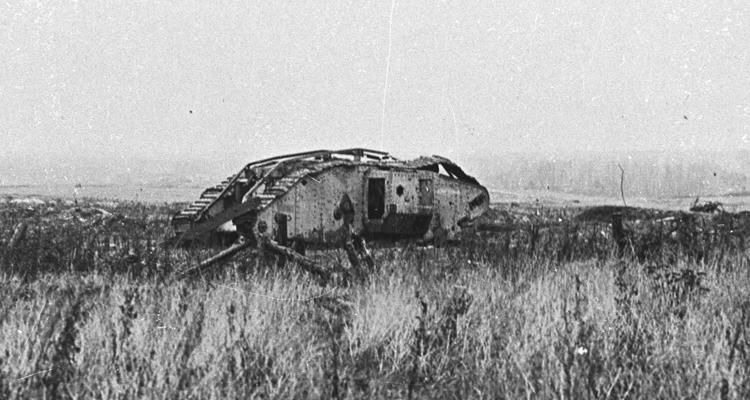
One of the crew, Private Joseph Mossman, described what happened next: “Captain Wain and Stower made a dash for the trench which was nearer their door. Roberts and I left by the opposite door and were fired on by a German rifleman at point blank range. Fortunately, he was a poor shot and we made the trench. Our only weapons were revolvers carried by Captain Wain, Roberts and myself. Captain Wain got on the parados (the back of the trench) and threw German ‘tater-masher’ bombs into the long grass.“
Wain then grabbed a Lewis machine gun and advanced towards the strongpoint, firing as he went. He captured the German strongpoint, took several prisoners and destroyed four trench mortars and two machine guns. He refused medical attention.
Rifleman Walter Wilkinson wrote later: “I chanced to look back at the disabled tank. As I did so, Captain Wain, with his tunic torn away at the front, his chest covered in blood, and in a pretty bad way, jumped into the trench by my side and shouted, “Give me a b….y rifle!” That’s all he said. I saw him snatch a rifle, put it to his shoulder, fire two rounds, and was himself shot dead in the head. He dropped, a lifeless corpse, by my side.“
Richard Wain was taken unconscious to a dressing station where he died. He was buried about 200 yards south-east of his tank besides the Villers-Plouich-Marcoing Road but the grave was later lost and he is now commemorated on the Louverval Memorial, as are Lieutenant Duncan and Private J A Browning, the other dead members of the crew. Wain’s Victoria Cross was only the second to be won by a soldier serving with the Tank Corps and the only one awarded to the Tank Corps at Cambrai.
We will remember him
Bridgend-born centenarian remembers VJ Day
A French town remembers a Barry war hero
News, Letters, Sport and advertising are welcomed by the Glamorgan Star – the largest newspaper or magazine in the Vale of Glamorgan. Contact us today here.
Pencoed tangled up by ‘Seaweeds’
Primary school’s former deputy head is banned from teaching
I make no apologies for calling Plaid Cymru ‘separatists’

‘The importance of participation and continued learning’

Opposition leaders clash with First Minister over independence rally

How Kevin saved a stranger’s life
Pensioners call for diesel generator to be moved

Price of alcohol to rise in Wales
Defence solicitor bought cocaine from client

⭐ All of our social media in one handy place – here