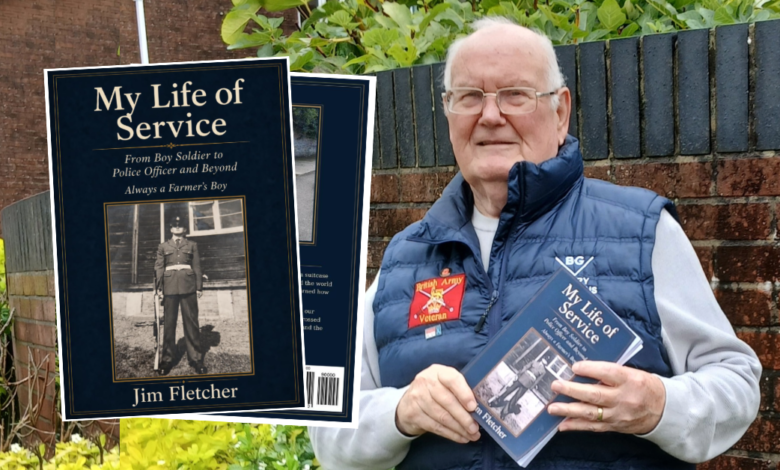


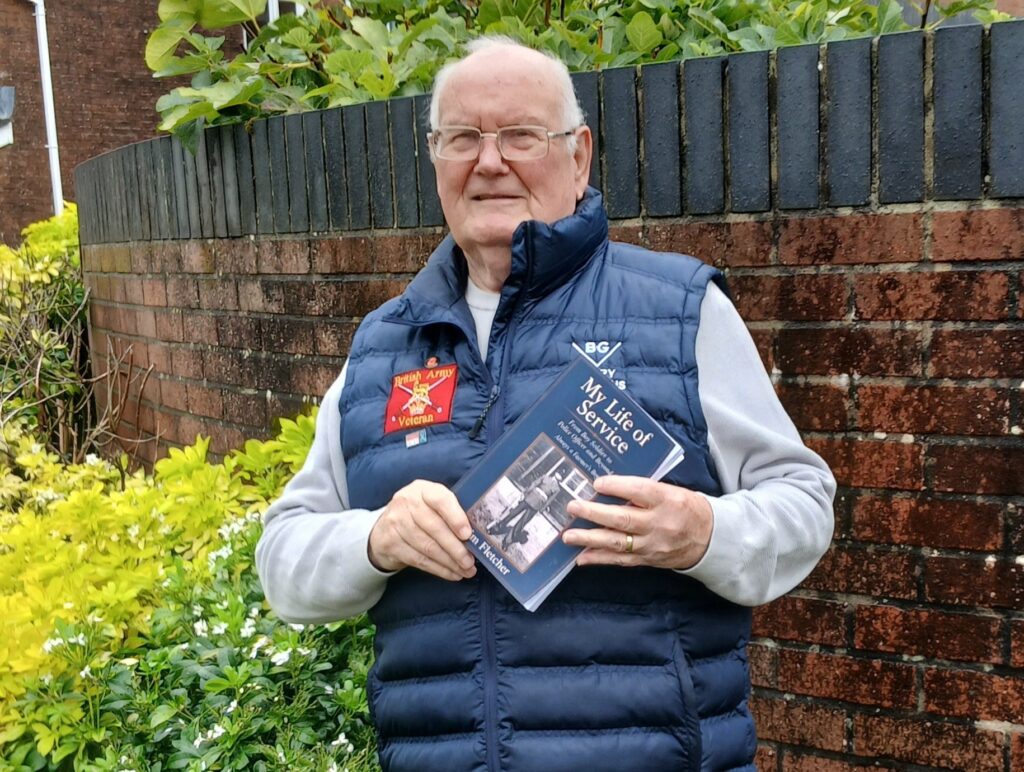
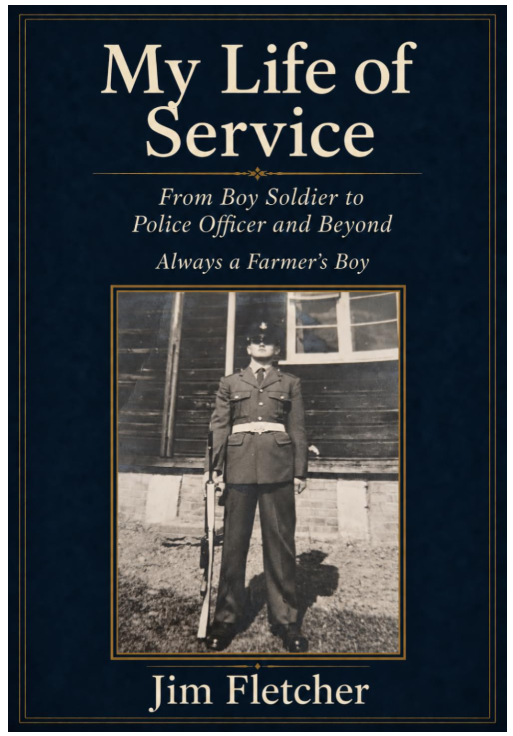
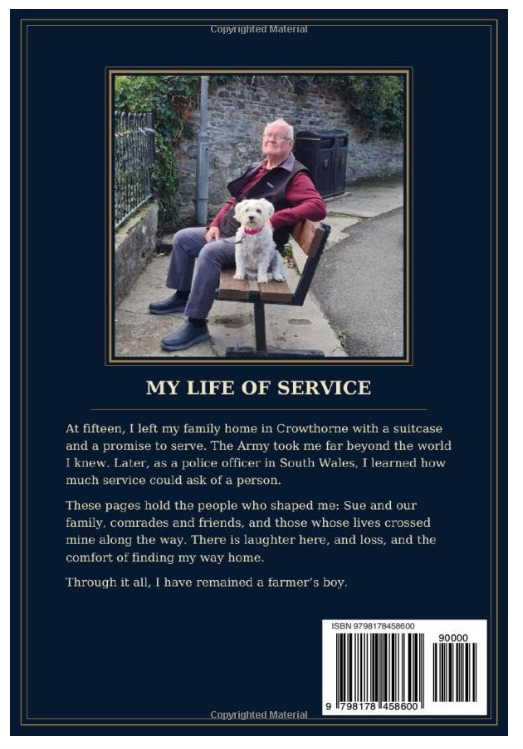
THE EXTRAORDINARY life story of Jim Fletcher, a former army sergeant who went on to have a long career as a police officer in Barry, is being told with the release of an autobiography to mark his 80th birthday.
Jim, who turns 80 today (Thursday), decided to write the book so that his children, grandchildren and future generations of his family will know his story, and to raise money for the Barry Veterans Group.
The book, My Life of Service: Always a Farmer’s Boy, refers to the nickname given to members of the Duke of Edinburgh’s Royal Regiment for which Jim served. Their quick march was The Farmer’s Boy, a traditional English folk ballad.
Jim grew up as one of nine children in Crowthorne, Berkshire, not far from the Sandhurst Academy, but his childhood was often unhappy. He said: “There was a real lack of warmth and affection from my parents. I cannot recall a single occasion where my father hugged me or said he was proud of me.
“I can clearly remember walking home from school one day and my father passed me in the street. He didn’t even acknowledge I was there.
“When one of my siblings was born my mother had a very bad childbirth, and I took an extended break from school for six weeks to look after the family. I remember not getting any acknowledgement for that at home, but when I returned to school, the headmaster, Mr Butcher, brought me to the front during assembly.
“I was made to stand on a box so that everybody could see me, and he told the school why I’d been away and presented me with a certificate. That was the only certificate I got from any of my schooling. It made me feel appreciated, and that never happened at home.”
As Jim got older, football became a refuge from his unhappy home circumstances, and Jack Elliott, who briefly played for Millwall, took him under his wing and gave him opportunities to play sports.
At the age of 15, Jim left the family home with a suitcase and a promise to serve. It was to be the start of an adventure that would see him travel the world and experience much comradeship, laughter, tragedy and adventure.
Jim’s childhood had a profound effect on him that influences the way he treats people to this day: “As I approached adulthood, I decided that I was going to be a very different person from my father.
“I made a promise that I’d always try and treat people the way I’d like to be treated myself. Of course, when I was an army sergeant, needing to be firm comes with the territory, but I hope I was always fair, and that people of all ranks considered me someone kind and supportive.
“I applied those same principles as a husband, a father and as a police officer, and it’s brought great rewards,” he said.
During Jim’s years in the army, he toured Northern Ireland in some of the most dangerous years of the troubles in the late 1960s, and he also spent time in Cyprus. One incident that occurred in Ulster brings Jim and his comrades some amusement all these years later: “The day we marched into Londonderry, we had our bayonets fixed, we had our tin hats on, we had a full magazine of rounds, but we had to put Sellotape on the top of it so it was impossible to feed the round into the chamber. So presumably if anybody started shooting at us, we’d have had to say, ‘excuse me a moment while I take my Sellotape off!’”
One piece of good fortune came when Jim attended a wedding, where he met his future wife: “I’d just been posted to Exeter to my regimental depot to train boy soldiers. I arrived on the Wednesday and I didn’t know most of the people, but one man told me he was getting married on the Saturday, and he said I was very welcome to come along. I wasn’t doing anything else, so I went to the wedding, and that was where I met Sue, who was one of the bridesmaids, and we’ve now been married for 58 years.”
They went on to have five children, two of whom were adopted: Nikki, Simon, Allan, Rebecca and James. Nikki was born in 1969 while Jim was serving in Northern Ireland and he was refused permission to take a weekend’s leave to go and see her. As a result, he did not get to see her until she was nearly three months old.
Jim left the army at the age of 26, but as one life of service ended, another was just beginning. He applied to join the police, and he was posted to Cardiff where he began his 30-year career. However, when his father-in-law suffered a serious heart attack, his superiors arranged for him to be transferred to Barry so Sue could visit and look after her dad more easily, and they have lived in the town ever since.
From his earliest days in the force, Jim knew that he wanted to remain at the sharp end of policing and never sought promotion beyond the rank of constable: “There are a number of jobs in life where the further up the chain you get promoted, the further away you go from the role you joined up for in the first place.
“I joined to uphold and enforce the law, and to serve the community. Being stuck behind a desk and attending endless strategy meetings wouldn’t have suited me,” he said.
Jim spent most of his long career on the beat in-and-around Barry, including spells as a patrol officer in Cadoxton and Barry Island when the holiday camp was at its peak. But one particular story during his time as area constable in St Athan sums up his approach: “One day, I was on the beat, and I saw graffiti on the bus shelter. I quickly found out who the youngsters responsible were.
“I gave them a talking to and said that the bus shelter, the telephone box and the various community facilities belonged to them, it’s not your mum’s village or your dad’s village, it’s your village, it’s our village, it’s for all of us. You wouldn’t smash up your television set at home because it belongs to you, well, the bus stop does, too.
“I gave their parents a choice. I told them I could arrest their children and they can then go through the courts and everything that comes with it, or alternatively, their children could paint the bus shelter. They chose the latter, and it was far more useful than putting them through the criminal justice system.
“The following day, I was driving through the area, and I had my daughter with me. I told her the story as we approached the bus stop, and when we passed it, I found it had already been sprayed with graffiti again. That bus shelter was painted three times in a single week, but then it wasn’t touched for two years. They’d learned their lesson without it leading to a criminal record.”
Over the course of his 30-year career, Jim saw many changes in the way police officers went about their jobs, and on occasion he carried out duties beyond the local area. He said: “When I began in the 1970s, we didn’t have all the gadgets you see police officers carrying today. We had our helmet and an 11-inch truncheon, that was it. There was no pepper spray, no Taser, no stab vest, and we didn’t routinely carry handcuffs. If we needed handcuffs, we had to call for backup. We talked our way out of situations and trouble in those days.
“During my career, I worked on several high-profile events. In April 1980, I was part of the South Wales contingent that helped our colleagues at Avon and Somerset Police deal with the St Paul’s riots in Bristol, and a few years later, there was the miners’ strike, where I was on duty at the picket lines in the valleys, as well as at Aberthaw Power Station and the cement works.
“That was a very challenging experience, and our duties were widespread. It wasn’t just about picket lines. We also had to police motorway bridges after a taxi driver (David Wilkie) was killed when a concrete block was thrown onto his vehicle when he was taking a non-striking miner to work.
“There were huge changes to the way we worked over the years. The Police and Criminal Evidence Act of 1984 (PACE) resulted in a very different working culture, and the technological advancements were enormous.”
When his career in the police ended, Jim worked as a student mentor at Michaelston College for several years before retiring. It was an experience he found highly rewarding: “I was able to relate to the students because I’d had a difficult upbringing myself. I’d say to them that you can achieve whatever you want to achieve, and nobody can stop you except yourself,” he said.
A few years ago, Jim went to visit his son Allan in Australia, but he felt unwell during the flight home and after landing at Heathrow, he was taken straight to the Royal Middlesex Hospital, where he was treated for pneumonia and related complications.
He said: “I was on various drugs and I was hallucinating and felt very confused for a while. When things started to ease, I found myself in a ward where, coincidentally, all four other men were old soldiers. We exchanged stories and had a strong camaraderie. There was a real sense of shared experience and kinship among us.
“One of them told me he’d written a book about his life, and that put the idea in my head to do the same thing.”
While serving in the military, Jim never felt he suffered from post-traumatic stress disorder (PTSD), despite having gone through very difficult experiences, but this changed several years ago when he began to suffer from nightmares and sleep paralysis, and he sought help after his granddaughter noticed he was not his usual self during a visit.
Jim began seeing a therapist, and, with the help of his family and his late dog Bonnie (a cross between a Miniature Schnauzer and a Bichon Frisé), he eventually came through his dark period: “During my career in the military and then in the police, I didn’t bring my problems home with me.
“I never came home from a shift in the police and told my wife and children I’d been dealing with the aftermath of a fatality in a road accident or a suicide. I’d bottled it up for years and years. My autobiography is very much ‘warts and all’, there are things my wife didn’t know, and my children certainly knew nothing about them.
“Writing the book was therapeutic, but it was also partly to give my family, including future generations, a greater understanding of my life and work.
“When I was a child, we were told ‘big boys don’t cry’ and the British stiff upper lip was the prevailing attitude.
“That attitude was supposed to make us resilient, but in many ways it was unhelpful. Long before my time, during and after the First World War, they used to call it shellshock. That generation, and the generation after it that fought in the Second World War often resorted to drink to cope.
“It could be very destructive, because it would lead to a difficult home life and they’d take their problems out on their wives and children.
“I’m glad we’re much more open about mental health nowadays, and while things are far from perfect, the resources are much better than they were in the past. I benefitted from counselling through Veterans NHS Wales when I was in my 70s, and I would encourage others who have traumas from their time in the military to do the same. It’s nothing to be embarrassed or ashamed of.
“When I told the therapist my life story, he said there was a pattern whereby I always put others first and myself second. I realised he was right, and that I needed to pay more attention to my own wellbeing.
“I’ve grasped that there’s a balance to be struck. I’ll continue to be a kind and supportive person, but I can only do that effectively if I take time to look after myself as well,” he said.
As his 80th birthday drew near, Jim reflected on his life and the things he is most proud of: “My wife and children gave me so much joy, and they continue to do so.
“I never differentiate between our biological children and the two we adopted. All five are ours, no ifs, no buts, and I’m delighted with how they’ve turned out. All of them have university degrees, that’s down to their work, not mine. They’re really nice people and are a credit to society. Our youngest son is autistic, that has brought its challenges but he’s gone on to achieve so much in life, he’s a lovely young man.
“It’s been wonderful to watch them grow up and then for them to have children of their own. I love spending time with my six grandchildren, three of whom are adopted by Nikki. Two are in Australia, the other lives more locally and is half-Japanese through Simon’s wife. I try and impart wisdom to them, but it’s a two-way street, because we learn from each other. I think it’s important for the different generations to interact and to understand one another’s perspectives.
“Beyond that, it’s great to see people I’ve mentored and encouraged make the most of their lives. I’ve encountered so many people, and I’ve been involved in a number of organisations. I was chair of governors at Gladstone Primary School for 18 years.
“A couple of months ago, I received a letter from a lady. In 1974, there had been a road accident that I dealt with. The lady was a five-year-old girl at the time, and she said in the letter that she’d been trying to track me down for years.
“She wanted to thank me for the way I treated her and her mum. It was the girl’s birthday a few days later and she said I sent her a card.
“To be honest, I couldn’t recall the accident or sending her a card, but I found it incredible that after all these years, somebody still wanted to say thank you, and that really was worth its weight in gold,” he said.
Discussing his plans for the future, Jim said: “My body feels as though it’s slowing down now and again, but I’m in pretty good shape overall. I’ll continue to make the most of my life and show people kindness and compassion whenever I can. I’ll continue to work with the veterans, I have a reputation for being outspoken and if things aren’t right, I’ll always make my views known.
“I never really returned home to Crowthorne after I left when I was 15 because my childhood was so unhappy, but in recent years I’ve built up a relationship with some of my brothers and sisters and I look forward to seeing more of them.
“When the time comes for me to leave this world, I want my ashes to go in with those of my beloved dog Bonnie, who is sadly no longer with us. She was a wonderful companion and support to me during my mental health difficulties a few years ago.
“But for now, I’m looking forward to my birthday celebrations. We’ll have a small-scale family tea on the day itself because it falls on a weekday, and I’ll be visiting my eldest son in Oxford in a few weeks. I drink very little alcohol most of the time, but it’s a running family joke that I seem to make an exception when I’m around my sons – they lead me astray! I’m sure we’ll have a great time.”
My Life of Service: Always a Farmer’s Boy by Jim Fletcher is available now on Amazon. Members of the Barry Veterans Group will be able to buy copies at a reduced price, with the money raised going to the organisation.
By Marcus Stead – News Reporter
- Barry policeman reflects on a life full of lessons
- New book looks at the history of Llantwit beach
- Cowbridge WWII veteran was inspiration for new book
- Cycling – the perfect way to enjoy the Vale’s pubs
News, Letters, Sport and advertising are welcomed by the Glamorgan Star – the largest newspaper or magazine in the Vale of Glamorgan. Contact us today here.
Housing association says it has tried to meet local aspirations

Pencoed RFC pipped at the post by South Gower
The King to attend the Senedd since its expansion from 67 to 96 members

New cafe and bar planned for Bridgend high street
Coach Matt says Barry RFC are starting to click

Rhoose and Cwm Talwg set the pace


j


⭐ All of our social media in one handy place – here