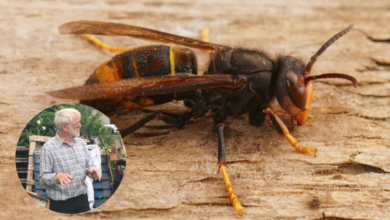
‘The bees needed their honey much more than I did’
News from the Fonmon Apiary with Harold Williams



THE daylight hours are now much reduced but dry days and temperatures in the teens are providing ideal conditions for my colonies to get out foraging and stock up with pollen and nectar.
All of the colonies are well provisioned. This is because this year I have not removed any honey from any of the colonies. This non-removal of honey was arrived at due to the very unsettled weather pattern this year. Wind and rain on many days meant that bees have been confined to their hives, the Queens kept up their egg laying and as a result colony numbers were high.

It is essential therefore to ensure that every colony has sufficient food stocks to tide them over in these conditions. Had I taken honey, it would have certainly left a couple of colonies struggling to cope with the varying conditions, and I would have had to feed them to prevent them from dying out. The bees needed their honey much more than I did.
Going into the winter months, the usual pattern would be for each colony to consist of a brood box and one super, both of which would be well filled with honey and pollen. However, my colonies have a brood box and 2/3 supers on them still. This format will persist throughout the winter months. Indeed, Barbara and I left an extra super on all colonies for the winter months of 2023. We did take some honey, however. Given that the spring this year (2024) was a complete washout, our decision to leave extra supers proved very beneficial for our bees. Having sufficient in-house stores allowed them to ride out the harsh 2024 spring.
The mild winter months that are becoming the norm now mean our bees are active when they should be less so. Any activity requires food to supply the energy; this equates to diminishing food stocks. Winter losses, whilst not unusual, are very often due to starvation. It behoves all beekeepers to be aware of these milder winters! Climate change is now visible; our bees are indicating it is so. Another indicator is our Queens! Although they have reduced the number of eggs they are laying, they have not stopped, as they should have.
Brood can now be found throughout the year. As a beekeeper with some 40+ years under my belt. Just as the bees are changing their behaviour, I must follow suit. The Varroa mite will require careful monitoring!
The above News from Fonmon Apiary report first appeared within the printed edition of the Glamorgan Star, dated Thursday, 14th November 2024.
Send us your News, Sport, Events, Letters and Advertising here.
- Pencoed tangled up by ‘Seaweeds’

- Primary school’s former deputy head is banned from teaching

- I make no apologies for calling Plaid Cymru ‘separatists’

⭐ All of our social media in one handy place – here

Pencoed tangled up by ‘Seaweeds’
Primary school’s former deputy head is banned from teaching
I make no apologies for calling Plaid Cymru ‘separatists’

‘The importance of participation and continued learning’

Opposition leaders clash with First Minister over independence rally

How Kevin saved a stranger’s life