
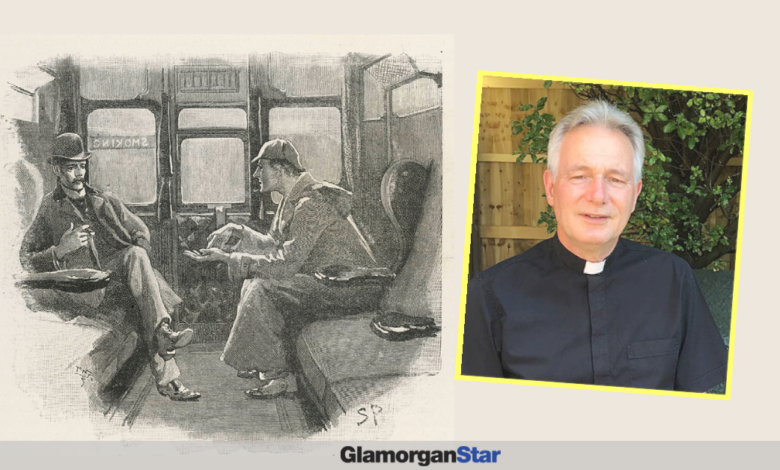


“Outrageous!” spluttered Watson.
“What is the matter old fellow?”, asked Holmes.
“It’s this article in The Jupiter, ‘Did Jesus rise from the dead?”.
“Ah yes”, replied Holmes “very interesting.”
“Interesting! It’s disgraceful.”
“What do you object to in it?” enquired Holmes.
“I particularly object to the suggestion that Jesus didn’t rise bodily on Easter Day.”
“But Watson, there is nothing new in the article. Scholars have been saying such things for decades. Have you ever thought about the ending to St Mark’s Gospel, which many think was the original Gospel? Some women followers of Jesus go to his tomb on the Sunday morning, to anoint his body with aromatic oils.
“They were wondering who would roll away the heavy stone at the tomb’s entrance for them. Then a young man appears to them. He tells them Jesus has risen, and they are to instruct his male followers to go to Galilee, where he will meet with them. But the women say nothing to anyone, because they are afraid. Watson, why were the women going to the tomb in the first place if they had no-one to move the stone away for them? And how was the message to get out, if the women remained silent?’ (Mark 16 v1-8)
“Goodness, Holmes, I have never thought of that!”
“And think about the letters of St Paul. He says a lot about the resurrection of Jesus, but he never mentions women finding an empty tomb (1 Corinthians 15 v3-11). So perhaps Jesus rose from the dead spiritually but without his body. ‘Put to death in the flesh but made alive in the spirit.’ (1 Peter 3 v18). The Jews had a belief that at the end of time everyone would be raised bodily (Daniel 12 v2). So someone who had had a vision of Jesus might automatically assume that he had risen in his body.”
“So where did the story of the empty tomb come from?” asked Watson.
“When, decades after the death of Jesus, the Gospel writers wrote their accounts of his life, they had to conclude with his tomb being found empty, because Christians assumed Jesus had risen bodily. But St Mark’s words that the women ‘said nothing to anyone’ indicates that the story he relates is one that no-one had heard before.”
“So what really happened at the first Easter, Holmes?”
“After the death of Jesus, the disciples returned north to their homes in Galilee. (Mark 16 v7, Matthew 28 v10, John 21 v10). Galilee was outside the jurisdiction of Pontius Pilate, so there was less chance of them being rounded up there.
“They returned to their work as fishermen, and while they were out fishing Jesus appeared to them (John 21). Emboldened by their encounter with Jesus, the disciples returned to Jerusalem to publicly proclaim his resurrection and lordship. It was the feast of Pentecost when they arrived there, a harvest festival which falls 50 days after Passover. The city was crowded with pilgrims, so it was an opportune time.”
“I have two questions to put to you, Holmes. First, why does the New Testament say Jesus rose ‘on the third day’ if he didn’t appear to his disciples until they had returned home, and resumed work? That wouldn’t all have happened in just a few days. Secondly, why didn’t the chief priests produce the body of Jesus to disprove the story of the resurrection, if it was still around?”
Holmes replied “The disciples believed Jesus had risen on Sunday because they were Jews who knew their scriptures. (1 Corinthians 15 v4; Jonah 1 v17; Hosea 6 v2). The Book of Genesis (Chapters 1 and 2) says that God began creation on the first day of the week (Sunday) and rested from his work on the seventh day (Saturday). So if Jesus rested in his tomb on Saturday, it would be appropriate for him to rise on Sunday, the day of creation.
“As to why the priests didn’t produce the body of Jesus, would the production of a mutilated, decomposing body ‘marred beyond human semblance’ (Isaiah 52 v14) undermine the faith of people who had seen Jesus? It could be the body of one of those crucified with Jesus.”
“What you are saying may be true Holmes, but what if those appearances of Jesus were just hallucinations experienced by bereaved people? Then our faith would be futile.”
“Watson”, replied Holmes, “If Jesus had wanted to provide incontrovertible proof that he was God’s Son, he would have come down from the cross and confounded his enemies (Matthew 27 v42). According to St Mark, the women who visited the tomb of Jesus encountered a heavenly messenger, yet despite this proof they still failed to deliver his message, due to fear (Mark 16 v8).
“Yet when the centurion who had organised Jesus’ execution saw the manner of his death, he declared publicly ‘Truly this man was the Son of God.’ (Mark 15 v39). He asked for no proof but made his confession of faith when all appeared lost. He hoped against hope. And that is the only sort of faith worth having.”
- The views expressed by columnists of this newspaper do not necessarily reflect the views of the Glamorgan Star, its employees, or proprietors.
Read next:
- I’m proud that all parties agreed on children in care plan
- Royal Welsh highlights the role of the rural economy
- My personal journey will drive my work in the Senedd
- The Vale: At the Heart of Britain’s AI Revolution
- The bees are clustering to survive the northern winds
⭐ All of our social media in one handy place – here


Former Barry office building transformed into vital new homes

Prolific thief banned from entering shops in Barry

I’m proud that all parties agreed on children in care plan

Royal Welsh highlights the role of the rural economy

Parent may have to lose job for school run

Double victory for Pencoed cricketers